Shared Responsibility Model Explained
May 28, 2026 | Cloud Security
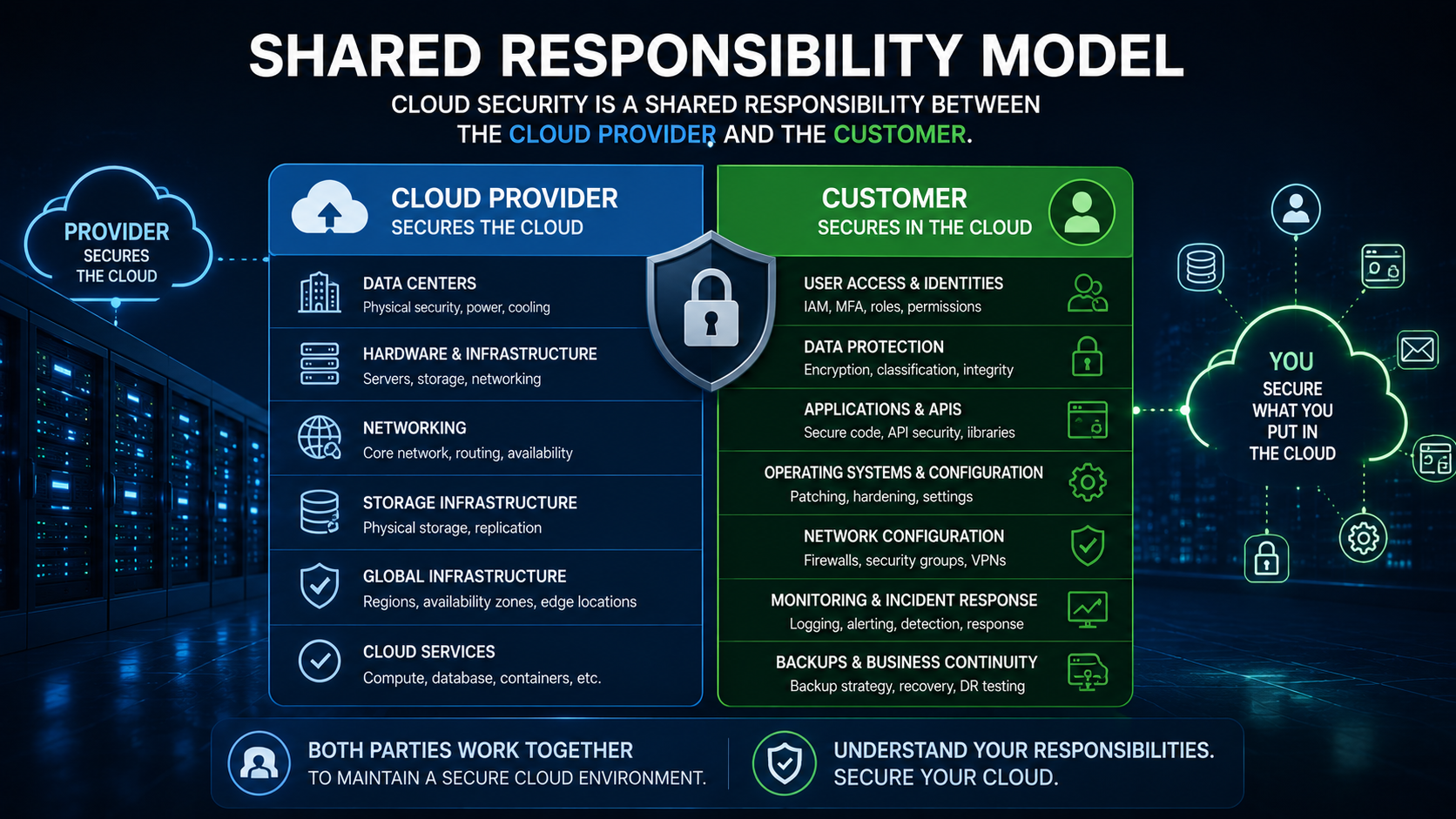
Cloud security is often misunderstood. Many businesses assume that once they move systems and data to a cloud provider, the provider becomes fully responsible for securing everything.
In reality, cloud security is shared between the provider and the customer. This is known as the shared responsibility model.
Understanding this model is essential for protecting cloud environments, avoiding security gaps, and meeting compliance requirements.
What Is the Shared Responsibility Model?
The shared responsibility model defines which security tasks belong to the cloud provider and which tasks remain the responsibility of the customer.
Cloud providers such as AWS, Microsoft Azure, and Google Cloud are responsible for securing the underlying cloud infrastructure. This includes the physical data centers, hardware, networking, and core cloud services.
Customers are responsible for securing how they use the cloud. This includes user access, data, applications, configurations, and workloads.
In simple terms, the cloud provider secures the cloud itself, while the customer secures what they put in the cloud.
What Cloud Providers Are Responsible For
Cloud providers manage the security of the infrastructure that powers their services.
This typically includes:
• Physical data center security
• Server hardware
• Core networking infrastructure
• Storage infrastructure
• Cloud service availability
• Environmental controls
• Infrastructure-level resilience
Providers invest heavily in protecting their global infrastructure, but their responsibility usually does not extend to customer-side mistakes such as weak passwords, exposed storage buckets, or misconfigured permissions.
What Customers Are Responsible For
Customers are responsible for securing their own cloud usage. This responsibility can vary depending on the type of cloud service being used.
Common customer responsibilities include:
• Managing user identities and permissions
• Enabling multi-factor authentication
• Securing applications and APIs
• Encrypting sensitive data
• Configuring firewalls and network rules
• Monitoring logs and suspicious activity
• Patching operating systems and workloads
• Backing up critical data
• Responding to security incidents
Most cloud breaches happen because of customer-side configuration issues, not because the underlying cloud provider infrastructure failed.
How Responsibilities Change by Cloud Service Type
The shared responsibility model changes depending on whether a business uses Infrastructure as a Service, Platform as a Service, or Software as a Service.
With Infrastructure as a Service, customers have more control and more responsibility. They may need to secure operating systems, applications, runtime environments, and network settings.
With Platform as a Service, the provider manages more of the underlying platform, while customers remain responsible for applications, data, access, and configurations.
With Software as a Service, the provider manages most technical infrastructure, but customers are still responsible for user access, data handling, security settings, and account management.
The more control a business has, the more security responsibility it usually carries.
Common Misunderstandings About Cloud Responsibility
A major cloud security risk is assuming the provider handles more than they actually do.
Common misunderstandings include:
• Believing cloud storage is private by default
• Assuming all backups are automatically protected
• Thinking the provider manages user permissions
• Assuming compliance is automatic
• Believing cloud applications are secure without testing
These assumptions can lead to exposed data, weak access controls, and compliance failures.
Why the Shared Responsibility Model Matters
The shared responsibility model matters because unclear ownership creates security gaps.
When businesses understand exactly what they are responsible for, they can build stronger controls around access management, encryption, monitoring, backup protection, and incident response.
This model also helps organizations improve compliance by documenting who owns each security control and how risks are managed.
Without a clear understanding of responsibility, businesses may believe they are protected when critical security tasks are actually being left unmanaged.
How Businesses Can Apply the Shared Responsibility Model
Businesses should treat the shared responsibility model as a practical security framework, not just a cloud concept.
Key steps include:
• Map responsibilities for each cloud service
• Review provider documentation
• Assign internal ownership for security controls
• Enable MFA and least privilege access
• Monitor cloud activity continuously
• Test cloud configurations regularly
• Include cloud responsibilities in compliance documentation
By making responsibilities explicit, organizations reduce confusion and improve accountability.
Shared Responsibility Is Not Shared Accountability
Although cloud security responsibilities are shared, businesses are still accountable for protecting their own data, users, and applications.
If customer data is exposed because of a misconfigured storage bucket, weak access policy, or compromised administrator account, the business using the cloud service is usually responsible for the impact.
This is why cloud security assessments, penetration testing, and regular configuration reviews are so important.
The cloud can be highly secure, but only when both the provider and the customer fulfill their responsibilities.
Return to blog
